


Your cart
There are no more items in your cart
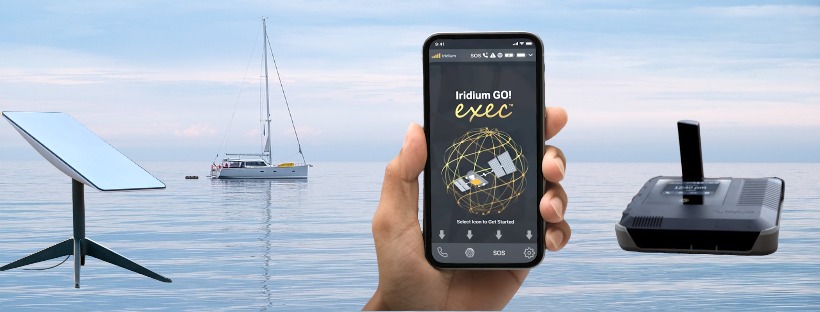
Starlink vs. Iridium: Which Is the Best Solution for Your Satellite Communications at Sea?
The launch of Starlink has shaken up the world of satellite communications, sparking enthusiasm among many boaters at the prospect of finally having high-speed internet on their boats. This arrival has largely overshadowed the launch of improved offerings from established operators, primarily Iridium and its new Go! Exec device. Yet this offering has plenty of advantages for an ocean crossing!
1/ The Starlink offer
Starlink, owned by SpaceX, is a constellation of thousands of small satellites placed in very low Earth orbit, enabling low latency and very high data rates. The trade-off is that an astronomical number (no pun intended!) of satellites is needed to cover the entire globe. While Inmarsat operates with just 3 geostationary satellites, Starlink had already placed nearly 5,000 satellites in orbit by the fall of 2023, with a target of 12,000 to deploy the full range of services—and plans to scale up to 42,000!
The performance is there: with speeds of up to 220 Mb/s—somewhere between ADSL and fiber optics—Starlink provides internet access just like a home router, allowing users to enjoy all the services available via “terrestrial” connections: email, web browsing, audio and video streaming, and more...

Travelers can choose between two plans:
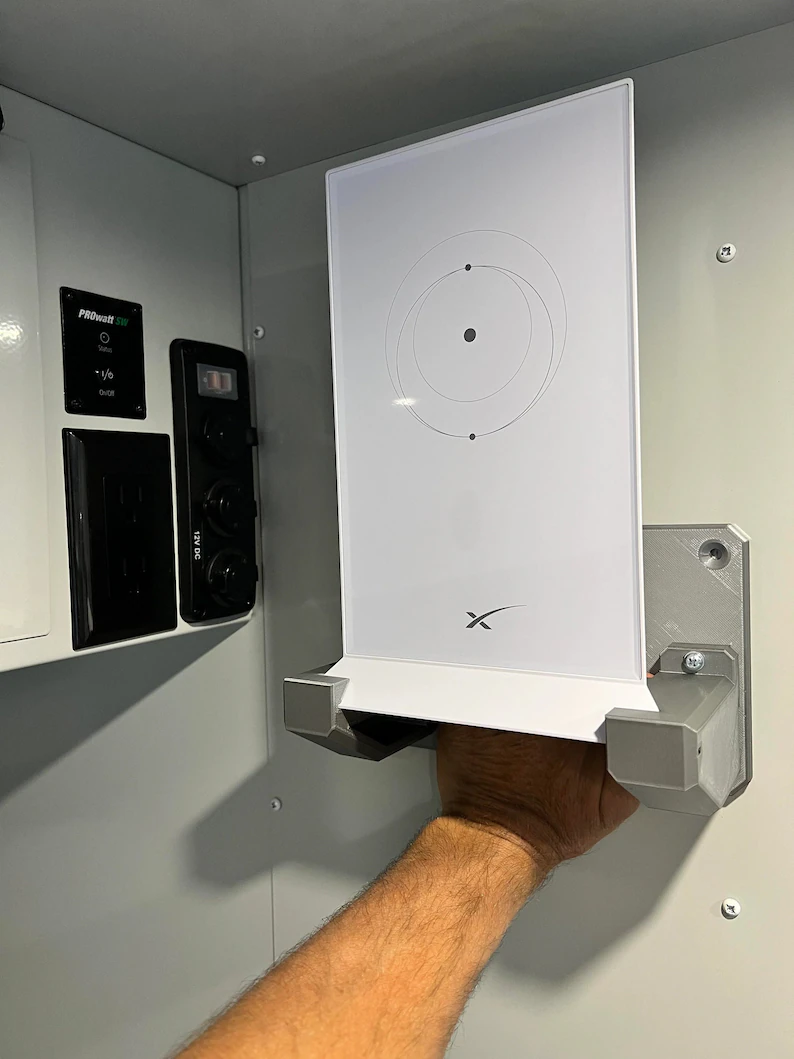
- Starlink Roam: Designed primarily for RVs, the Roam plan features a relatively low-cost motorized antenna (€450 at the time of this writing, though Starlink’s pricing policy varies widely) that allows for use in “stationary mobility” or at very low speeds. This antenna is not designed to withstand a salty environment or to compensate for a boat’s rolling motion. The Roam plan is “regional,” meaning access is restricted to a specific geographic area. However, it is possible to upgrade to the “Mobile Global” plan for “global” access (which is effectively limited to coverage areas; see below). While coastal areas are covered, this is not the case for ocean crossings (for which the “Mobile Priority” plan is required, which is not available with the Roam antenna).
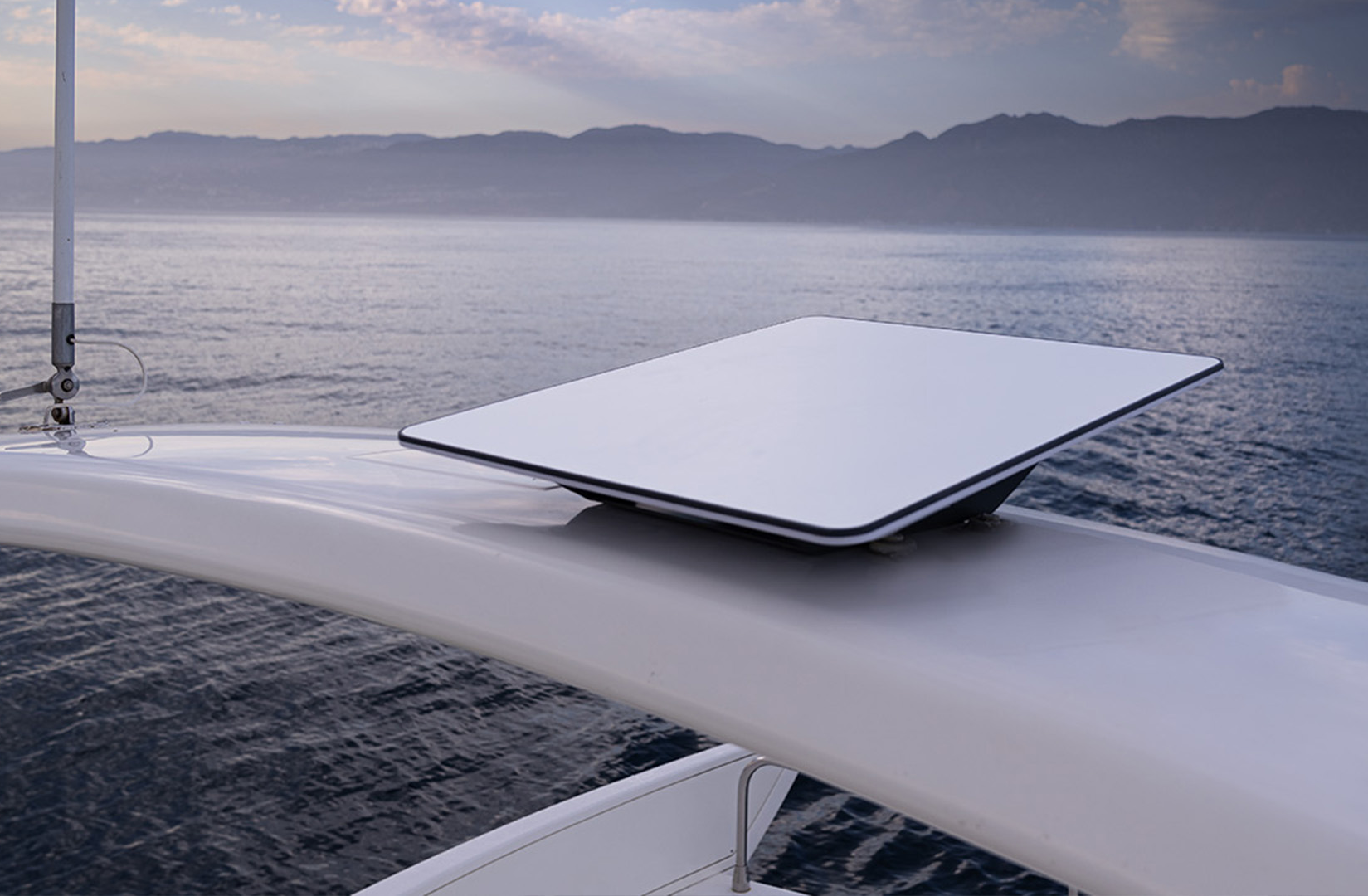
- Starlink Maritime: As its name suggests, this service is intended for recreational boaters. It relies on a fixed, “high-performance” antenna with a wider beamwidth that is marine-rated (IP56) and designed for use at sea. The cost is significantly higher (currently €2,826), and subscriptions require at least the Mobile Global plan. For ocean crossings, the Mobile Priority plan is required at a minimum (see table).
Starlink’s coverage is still far from global (see map here): it notably still excludes all of Africa, part of South America, and a large portion of Asia—not to mention, of course, countries under a service blackout (China, Russia, Venezuela, Cuba, etc.).
Furthermore, the Starlink system is quite bulky and requires a fixed installation: you’ll need to mount the antenna on a gantry or on the deck, run cables, and so on—there’s no way you can take it with you for a weekend or on a rental boat. The relatively high power consumption, requiring a 110/220V power supply, is also something to consider.
2/ The Iridium Go! Exec offer
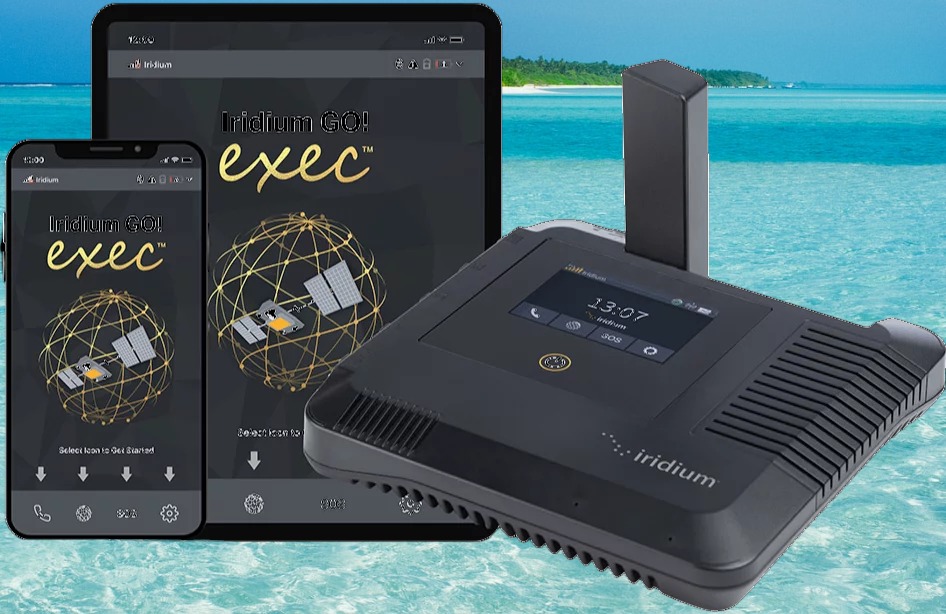
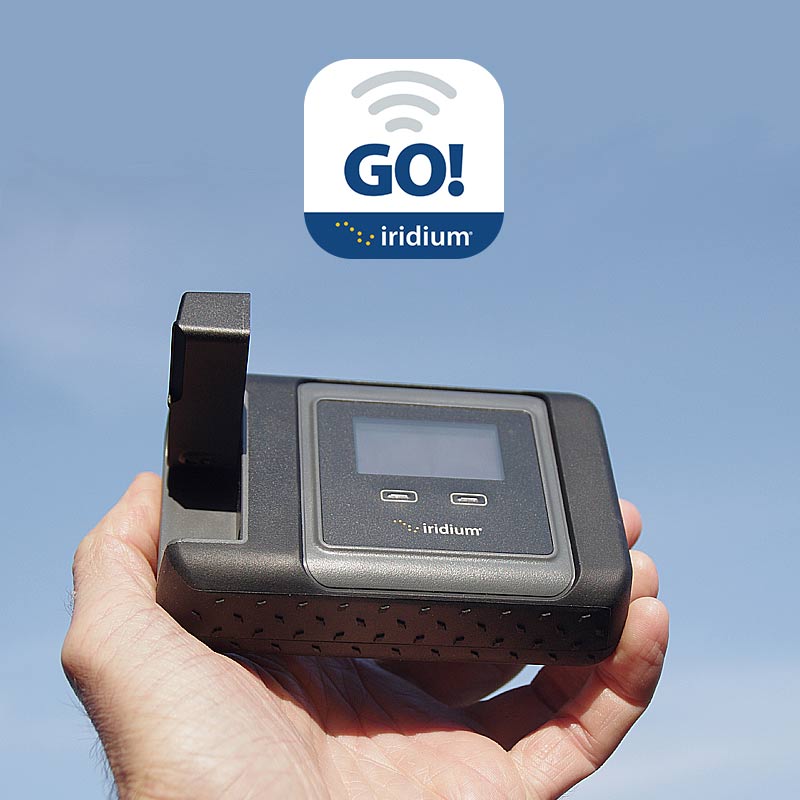
The Iridium Go! Exec is an evolution of the well-known Iridium Go! device (see below) designed for more professional (“Executive”) use. A detailed description of this device can be found in our product sheet. The Iridium service relies on the Certus constellation, consisting of 66 satellites in low-Earth orbit, providing 100% coverage of the globe. These satellites offer various channels with different data rates. The Go Exec! uses the Certus 100 service, which is the most affordable option for recreational boaters.

While the Iridium Go! Exec can't compete with Starlink in terms of data throughput, this device has other advantages that make it worth considering for sailors. It was developed with a set of specifications entirely different from Starlink’s, aiming for a balance between portability and a user-friendly communication experience that closely mirrors what we’re used to on land.
The Iridium Go! Exec is therefore a portable, fully self-contained, battery-powered device. It charges via a standard USB-C port. It features its own built-in antenna (an external antenna is available as an option for metal-hulled boats). It allows you to use standard digital tools (web browsers such as Chrome or Firefox, email clients such as Gmail or Outlook, messaging apps like WhatsApp or Telegram, etc.) from a smartphone, tablet, or computer. Its touchscreen also allows for standalone phone calls (2 phone lines) and includes an SOS function with geolocation for maritime emergencies.
The Iridium Go! Exec is waterproof (IP65) and ruggedized to withstand impacts and drops. It is therefore a device designed from the outset for mobile use, unlike Starlink.

3/ The Iridium Go! Offer
The Iridium Go! has been well known among boaters since 2015. We won’t go into a detailed description here, but you can find one in our product sheet.
Among its strengths, it’s a very compact device that’s easy to take anywhere and completely self-contained. Despite its very limited data throughput, it handles essential communication tasks at sea quite well: checking the weather, emails, text messages, and phone calls, as well as sending your location (tracking). It also features an SOS function that’s useful in an emergency. It’s a proven device with a fairly wide range of compatible weather and navigation apps (see our guide).
Another advantage is that it was the first Iridium device compatible with unlimited data plans. iTabNav offers “Flex” and “Rolling Month” monthly plans that ensure you don’t lose any days if your voyage spans from one month to the next (see our Iridium Go unlimited plans). Of course, the device is now outdated in terms of communication speed, but it remains a valuable option and is still available in the Iridium catalog. Even if you use Starlink, owning an Iridium Go! provides a very reassuring backup at sea.
4/ Our Comparison Chart
We have attempted to compile this information in the table below to give users the clearest possible overview when choosing a technology.
Starlink Go Exec Comparison
| Feature | Iridium Go / iTabNav | Iridium Go Exec / iTabNav | Starlink / Maritime | Starlink / Roam (standard antenna) |
| Power supply / Portability | Battery / Yes | Battery / Yes | Mains power / No (fixed installation) | Mains power / No (fixed installation) |
| Power consumption | Very low (USB) | Very low (USB-C) | High (110/220 V power supply, 6 A) | High (110/220 V power supply, 6 A) |
| Water resistance | IP65 | IP65 | Antenna: Yes (IP56) / router: No (IP54) | Antenna: No (IP54) / router: No (IP54) |
| Data speed | 2.4 Kb/s | 88 Kb/s | 220Mb/s | 100Mb/s |
| Unlimited data | Yes | No | Yes on land, no over oceans | Yes on land, no over oceans |
| Typical uses | Emails (text only) SMS Weather: small files (~100 KB) | Web browsing (Firefox, Chrome, etc.) Email (Outlook, Gmail, etc.), Messaging apps (WhatsApp, Telegram, etc.) Weather: medium to large files | Access to all standard internet services: Web browsing Email and messaging apps Audio and video streaming, gaming Weather: large files | Access to all standard internet services: Web browsing Email and messaging apps Audio and video streaming, gaming Weather: large files |
| Telephony | 1 line (US number) | 2 lines (US numbers) | IP telephony (Skype, WhatsApp, etc.) | IP telephony (Skype, WhatsApp, etc.) |
| Built-in SOS function | Yes | Yes | No | No |
| Built-in tracking | Yes | No | No | No |
| Built-in GPS | Yes | Yes (SOS only) | No | No |
| Connected devices | Mobile phones | Mobile phones and computers | Mobile phones, computers, gaming consoles, etc. | Mobile phones, computers, gaming consoles, etc. |
| Geographical coverage | Worldwide, including oceans | Worldwide, including oceans | Partial worldwide coverage with Mobile Global + ocean coverage with Mobile Priority | - Regional coverage with Mobile Regional - Partial worldwide coverage with Mobile Global |
| Costs | Iridium Go: €1,169 (incl. VAT) Unlimited data plan (Flex50): €209/month | Iridium Go Exec: €2,220 (incl. VAT) 25 MB plan: €139/month 50 MB plan: €215/month Unlimited data plan: €329/month | Antenna + router: €2,826 Mobile Global: €230/month Mobile Priority 50 GB: €287/month Mobile Priority 1 TB: €1,128/month Mobile Priority 5 TB: €5,656/month Additional data: €2/GB | Antenna + router: €450 Mobile Regional: €100/month (one continent) Mobile Global: €230/month |
| Advantages | - Extremely portable (pocket-sized) - Unlimited data - Covers essential needs: staying in touch with family and friends via email or SMS, downloading GRIB files - Rolling subscription periods (iTabNav) | - Good portability - Unlimited data option available - Use of standard applications for most everyday needs, excluding streaming - Rolling subscription periods (iTabNav) | -Outstanding data speeds (similar to home broadband) | -Outstanding data speeds (similar to home broadband) |
| Disadvantages | - Very low data speeds - Requires the use of Iridium apps | - Slow compared with Starlink - With a limited data plan, careful monitoring is required to avoid using up the data allowance too quickly | - Fixed installation - High power consumption - No SOS function | - Fixed installation - High power consumption - No SOS function - The standard antenna is not intended for use on boats - No ocean coverage |
5/ In summary
- Starlink is an extraordinary tool for work and entertainment, but it is not a device designed for boating or adventure in the broader sense.
- It offers a high level of user convenience—and a false sense of security, since the connection always seems to be available
- In an emergency, Starlink does not offer any alert functions, nor does it have the necessary power backup to remain operational in the event of a power outage on board. Similarly, the external antenna could be damaged, and under no circumstances should Starlink be taken aboard a life raft.
- Starlink is not suitable for nomadic use (hiking, exploration) or on a rental boat.
Therefore, in our view, Starlink should be used for its intended purpose: providing unparalleled internet access at sea. However, it cannot replace safety equipment that allows you to continue communicating during a storm.
We must also not forget to consider the environmental cost of these solutions: when all the climate warning lights are flashing red, launching more than 40,000 satellites using multiple rockets (even reusable ones...) and which have a lifespan of only 5 years does not seem like the most reasonable solution for the planet!
6/ In conclusion: How to choose!
If you already own an Iridium Go!:
There’s no need to switch! The device and subscription plans are still available. If you need higher-speed connections, you can add a Starlink Roam with a standard antenna (which will need to be protected), which will provide a comfortable user experience while at anchor or sailing along the coast at a reasonable cost. On the open ocean, you’ll use the Go for essential communications.
If you don’t own an Iridium Go!:
If you’d like to get a newer device that lets you stay in touch with loved ones via phone or WhatsApp, easily download weather reports, and browse the web using your usual tools—and if you can easily do without Netflix during an ocean crossing—the Go! Exec is perfect for you!
And even if you later decide to upgrade to high-speed internet at anchor (with the Roam plan and standard antenna), you’ll still come out ahead financially compared to the Starlink Maritime plan. Best of all, you’ll have a redundant setup capable of withstanding tough conditions.
If you’ve already gone for Starlink:
You’re surely aware that your device won’t be of any use in the event of a power outage or a maritime emergency. Of course, your EPIRB will send out an alert. But equipping yourself with an Iridium Go! or even an older Iridium 9555 handset will allow you to stay in contact with land—and, for example, avoid having to unnecessarily abandon your vessel once rescue teams have been dispatched to the area...
When the Iridium Go! is used as a safety backup, unlimited data is no longer necessary. We’ll soon be offering discounted plans with 5 or 75 minutes of data included (contact us for more information).